IMT Bawal runs on manufacturing, auto components, engineering, plastics, packaging, and a hundred other units supplying buyers across India and abroad. Yet plenty of these factories still run on a single-page site or no website at all. Meanwhile, the purchase manager evaluating them is doing homework online before he ever picks up the phone.
A manufacturer’s website isn’t a brochure. It’s a trust-building, inquiry-generating sales tool. This checklist walks through exactly what a manufacturing website in IMT Bawal needs to win B2B buyers, section by section, so nothing important gets left out.
Why a manufacturer’s website is different from a shop’s
A retail site sells to a walk-in customer who decides in minutes. A manufacturing site sells to a purchase manager or engineer who’s comparing suppliers, checking credibility, and building a shortlist over days. The buyer is cautious, technical, and often in another city. Your site has to answer his questions before he asks them.
That changes what matters. Pretty visuals help, but proof matters more: what you make, at what capacity, to which standards, for whom, and how to reach you. Get those right and your website does what a sales rep can’t, work every hour, in front of buyers you’ve never met.
The essential pages checklist
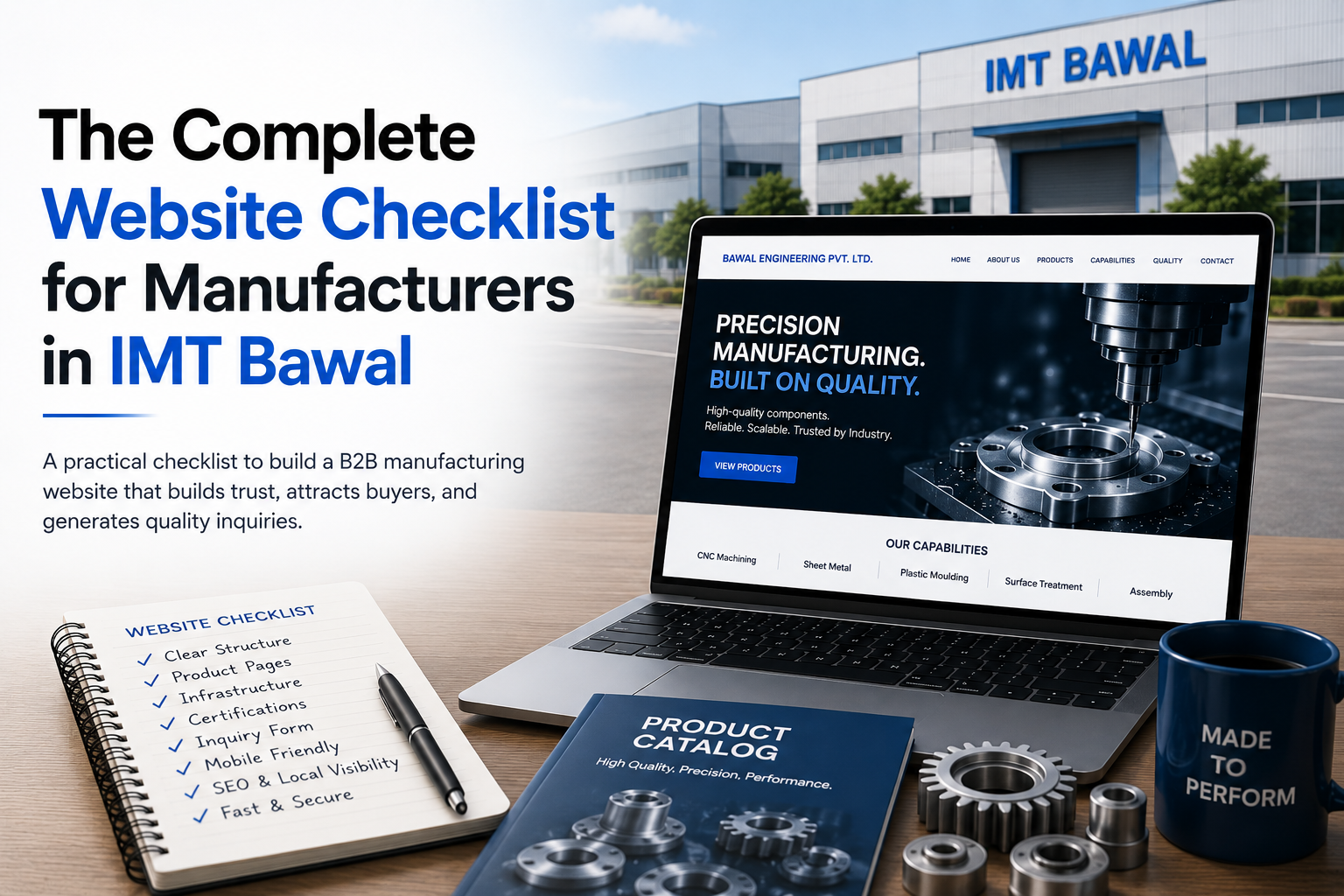
Start with structure. A manufacturing website should have these core pages, each doing a clear job.
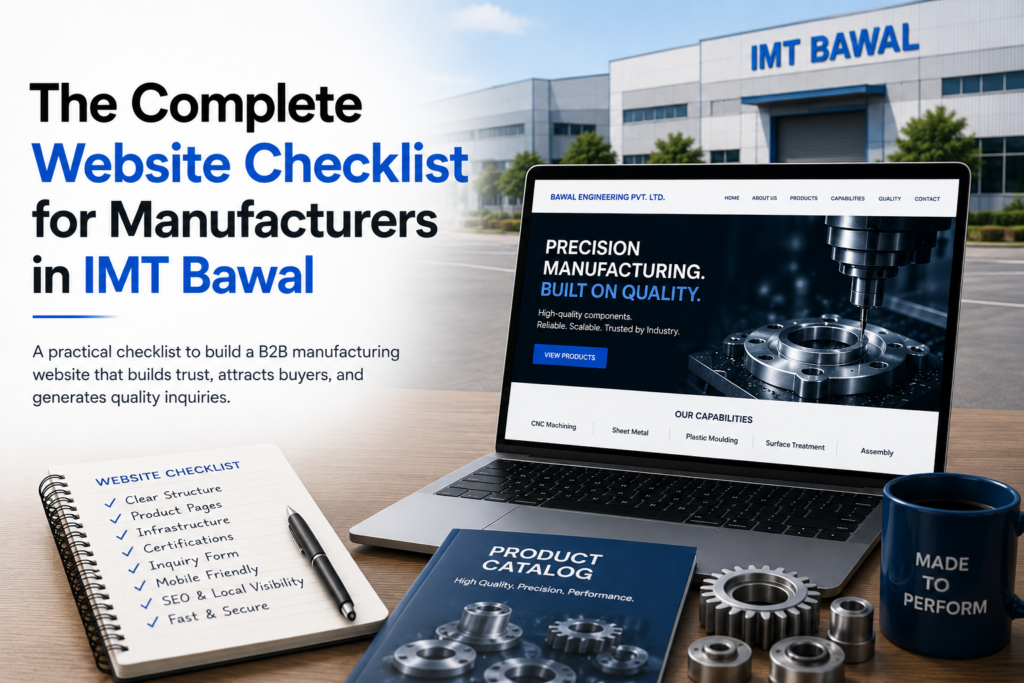
- Home: A clear headline stating what you make and who you serve, plus quick links to products and an inquiry button.
- About / Company: Your story, founding year, plant location in IMT Bawal, and scale. Buyers want to know you’re stable and real.
- Products / Capabilities: A page per product line or process, with specs. This is the heart of the site.
- Infrastructure / Manufacturing: Your machinery, capacity, and facility, with photos. Proof you can deliver volume.
- Quality / Certifications: ISO, IATF, and other standards, shown clearly.
- Clients / Industries served: Who you supply, by name or by sector.
- Contact / Inquiry: Multiple ways to reach you, with a proper inquiry form.
Product and capability pages that actually inform
This is where most manufacturing sites fall short. A single photo and a two-line description won’t cut it for a technical buyer. Each product or process needs real detail: dimensions, materials, tolerances, capacity, applications, and the industries it serves.
Add downloadable spec sheets or a product catalogue as a PDF. Buyers love to save and share these internally. If you offer custom manufacturing, say so plainly and explain your process. The goal is simple: a purchase manager should finish the page knowing whether you can make what he needs, without emailing you to find out.
Certifications and quality: your biggest trust signal
In B2B manufacturing, certifications are currency. ISO 9001, IATF 16949 for automotive, RoHS, or any industry-specific standard, these decide whether a buyer even considers you. Don’t bury them in a footer.
Give quality its own page. List each certification, show the certificate images or numbers, and mention your quality process, inspection, testing, traceability. If you supply to the auto sector around Bawal, Dharuhera, and Manesar, automotive standards are often a hard filter. Displaying them upfront can be the difference between making the shortlist and being skipped.
Infrastructure and capacity: prove you can deliver
A buyer placing a large order needs to know you won’t buckle under volume. An infrastructure page with real photos of your plant, machinery, and production floor does that quietly and powerfully. Numbers help too: installed capacity, number of machines, plant area, workforce size.
Real photos matter here as much as they do for a Google Business Profile. Stock images of generic factories fool no one. Show your actual IMT Bawal facility. It tells the buyer you’re an established operation, not a trader dressed up as a manufacturer.
Inquiry forms and lead capture done right
Every page should make it easy to ask for a quote. A dedicated inquiry form with the right fields, product interest, quantity, company name, location, and contact, turns a browsing buyer into a lead in your inbox. Keep it short enough that people finish it.
Pair the form with a direct WhatsApp number and a clickable phone number, since a lot of Indian B2B buyers prefer WhatsApp for quick queries. Make sure every inquiry actually reaches someone who replies fast. A form that dumps into an unchecked inbox is worse than no form, it promises a response you never send.
Mobile, speed, and English-first content
Your buyer might first open your site on a phone between meetings, on an average connection. If it loads slowly or looks broken on mobile, you’ve lost him before he’s read a word. A manufacturing site must be fast and fully mobile-friendly, non-negotiable.
Write in clear, professional English, since B2B buyers, exporters, and OEMs expect it. Keep the language simple and specific, spec numbers over adjectives. If you export or serve buyers who prefer Hindi, a bilingual option can help, but English is the baseline for national and international credibility.
SEO so buyers actually find you
A beautiful site nobody finds is a wasted investment. Manufacturing buyers search for specific things: “sheet metal components manufacturer Bawal,” “plastic injection moulding supplier Haryana,” “auto parts manufacturer near Manesar.” Your pages should target those real search terms.
Use product and location keywords naturally in page titles, headings, and content. Register a Google Business Profile so you appear on Maps for local B2B searches. Getting the SEO basics right early is far cheaper than fixing an invisible site later, as our cost breakdown explains.
The quick pre-launch checklist
Before your manufacturing website goes live, run through this fast:
- Clear headline stating what you make and who you serve
- Detailed product / capability pages with specs
- Downloadable catalogue or spec sheets (PDF)
- Certifications shown clearly on their own page
- Real photos of your IMT Bawal plant and machinery
- Capacity and infrastructure numbers
- Inquiry form plus WhatsApp and clickable phone
- Fast loading and fully mobile-friendly
- Professional English content with product keywords
- Google Business Profile linked and consistent
Tick all ten and you’ve got a website that works as a real sales channel, not a digital visiting card gathering dust.
Frequently asked questions
Why does a manufacturer in IMT Bawal need a website if buyers find them on IndiaMART?
IndiaMART brings inquiries, but buyers still check your own website to judge credibility before ordering. A proper site with capability pages, certifications, and plant photos builds trust that a marketplace listing can’t. The two work together, your website closes what the marketplace opens.
What’s the most important page on a Manufacturing website?
The product or capability pages, closely followed by certifications. Technical buyers decide based on whether you can make what they need to the required standard. Detailed specs, applications, and clearly displayed ISO or IATF certifications do more to win a shortlist spot than any amount of design.
Should a manufacturing website be in English or Hindi?
English is the baseline for B2B, exporters, and OEM buyers who expect it and often operate nationally. If you also serve regional buyers who prefer Hindi, a bilingual option helps. Keep the language simple and specification-driven either way, buyers want numbers, not adjectives.
How much does a manufacturing website cost in the Bawal area?
A solid B2B manufacturing website typically runs higher than a basic shop site because it needs detailed product pages, catalogues, and inquiry systems, often ₹35,000 upward, plus yearly hosting. See our Rewari cost breakdown for full ranges and what drives the price.
Build a website your buyers actually trust
If you run a unit in IMT Bawal and your website doesn’t yet do the things on this checklist, it’s likely costing you inquiries you never even know about. A proper B2B site changes that, quietly working as your always-on sales rep.
We build manufacturing and B2B websites for the Bawal and Rewari industrial belt. See our work at indriontech.com, or find us on Google Maps and let’s map out what your plant’s website should include.