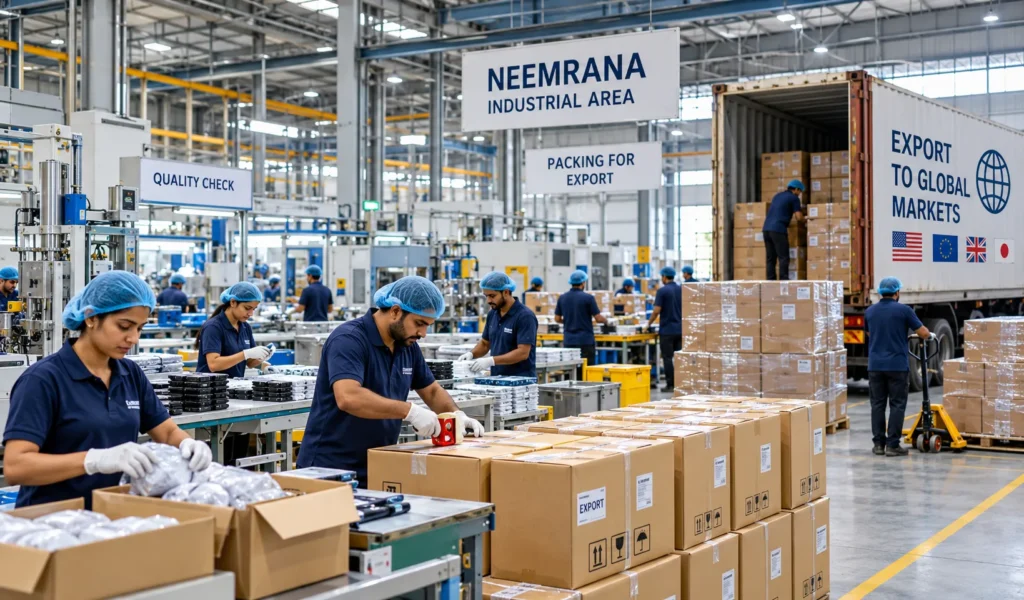
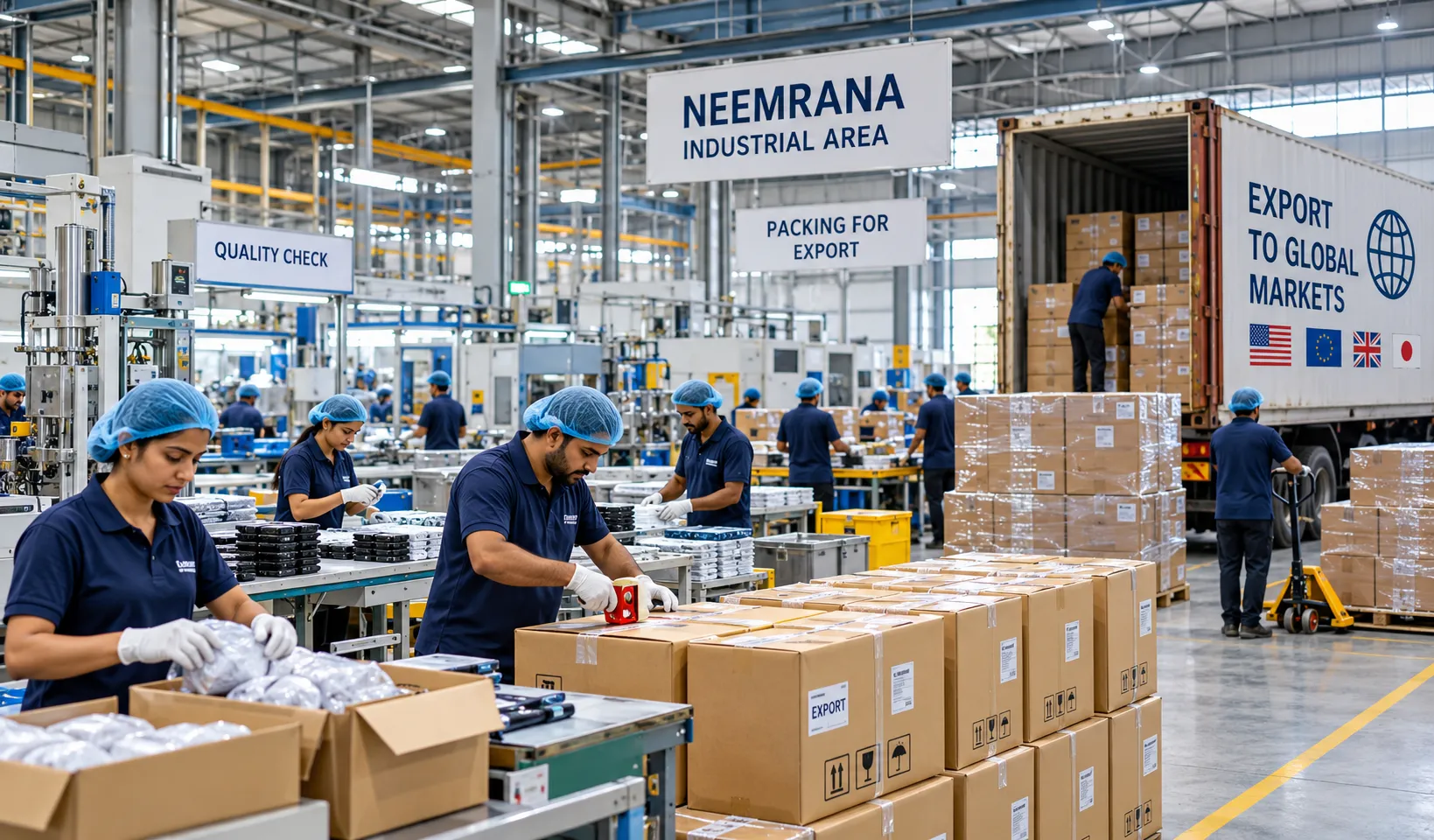
Neemrana makes things the world buys. Auto components, engineering parts, plastics, packaging, electricals, food products. Many units here already supply Japanese, European and Gulf customers through a parent company or an agent. Far fewer get export enquiries on their own, directly, from buyers who found them online.
That gap is mostly fixable. Overseas buyers and big domestic OEMs now shortlist suppliers on Google, LinkedIn and B2B portals before they send a single email. This guide is the practical website and SEO playbook we’d follow for a Neemrana manufacturer who wants those enquiries to land in their own inbox.
Why Neemrana manufacturers are well placed for export enquiries
Neemrana already has the reputation buyers look for. The Japanese Zone developed by RIICO is one of the best-known Japanese industrial parks in India, home to dozens of Japanese companies and their supply chains. Around them sits a large base of Indian suppliers that already work to Japanese quality, delivery and documentation standards.
That is a strong selling point, and most local websites hide it. “Supplier to Japanese OEMs in Neemrana” tells a buyer in Germany or Dubai more than three paragraphs of “quality is our motto.” Your location on NH-48, on the Delhi–Jaipur corridor and within reach of the region’s inland container depots, is also a logistics argument worth stating plainly.
The problem isn’t capability. It’s visibility. A buyer can’t shortlist a factory they never find.
Where export and B2B buyers actually look for suppliers
Most serious buyers follow a similar path, whether they sit in Stuttgart or in Pune:
- Search. They type the part, material or process plus words like “manufacturer India” or “supplier”, often with a spec or standard.
- Marketplaces. IndiaMART, TradeIndia, Alibaba and sector directories give them a long list fast.
- LinkedIn and referrals. They check who works at the company and ask peers.
- Your website. Before they email, they check whether you look real, capable and stable.
Step four is where many Neemrana units lose the deal. The buyer finds a name on a marketplace, searches for it, and lands on a two-page site with a stock photo, a Gmail address and no product specs. They move on, and you never knew they visited.
Why marketplace leads alone aren’t enough
Marketplaces work, and you should keep using them. But they have limits you should plan around.
The same enquiry often goes to several suppliers at once, so you start in a price war. You don’t own the listing, the ranking or the buyer relationship. And many portal leads are small traders, not the purchase managers you actually want.
Your own website fixes the ownership problem. An enquiry that comes through your site is yours alone. The buyer has already read your capability, seen your certifications and chosen to contact you. That’s a warmer lead than a broadcast RFQ, and it doesn’t cost you a per-lead fee.
The smart setup uses both: marketplaces for reach, your website for trust and direct enquiries.
What your website needs before it can win export enquiries
SEO brings visitors. The website decides whether they enquire. Fix these first, or the traffic leaks away. If you’re starting from scratch, our website checklist for manufacturers covers the full page list; below is what matters most for export buyers.
English-first product pages with real specifications
One page per product line, not one page for everything. Each should state materials, grades, tolerances, sizes, finishes and standards. Give dimensions in both millimetres and inches if you sell to the US. Add HS codes where relevant, because importers and their customs agents think in HS codes.
Write in clear, simple English. Your buyer may be reading in their second language too. Short sentences and spec tables beat flowery copy every time.
Proof that you can export
Buyers worry about three things: quality, delivery and paperwork. Answer all three on the site.
- Certifications: ISO 9001, IATF 16949, ISO 14001, CE or whatever applies, with certificate images.
- Export experience: Countries you’ve shipped to, the kinds of customers (named only with permission), and typical order sizes.
- Shipping terms: The Incoterms you work on (FOB, CIF, EXW), the ports or ICDs you ship from, and export packaging photos.
- Capacity: Monthly output, key machinery and lead times. Vague claims like “large capacity” don’t count.
An RFQ form built for buyers, not a generic contact box
“Name, email, message” is not enough for an industrial enquiry. Ask for product, quantity, target price (optional), destination country, preferred Incoterm, and a file upload for drawings. A good form saves two rounds of email and signals that you’ve handled export RFQs before.
Keep it short enough to finish in a minute. Put a WhatsApp button beside it, since many buyers in the Gulf and Africa prefer it.
Trust details that make you look established
Use an email on your own domain, not Gmail. Show your full factory address with a Google Map, your GST number, the year you started and real photos of the plant and team. Mention that you hold an Import Export Code (IEC) if you export directly. These small details answer the question every overseas buyer has: is this company real?
Speed on slow and distant connections
Your buyer may open the site on a phone in a hotel in Lagos or on a busy office network in Riyadh. Compress images, use decent hosting with a CDN, and keep heavy sliders off the home page. A site that takes eight seconds to load looks unprofessional before the buyer reads a word.
The SEO playbook for global and domestic buyers
Once the site can convert, make it findable. Industrial SEO is less about volume and more about matching the exact words a buyer types. Ten visits from the right purchase managers beat a thousand random clicks.
| Search type | Example query | Page that should rank |
|---|---|---|
| Product + origin | precision turned components manufacturer India | Product line page |
| Spec or standard | IATF 16949 certified sheet metal supplier | Product page with certification section |
| Process | CNC machining job work Rajasthan | Capabilities / process page |
| Location (domestic) | plastic moulding company Neemrana | Home page or location page |
| Problem / comparison | aluminium vs zinc die casting for auto parts | Blog article or guide |
Target products and specs, not slogans
Build each product page around how buyers name the product, plus words like “manufacturer”, “supplier” or “exporter” and “India”. Use the spec words in your headings and tables naturally. A page titled “Our Products” won’t rank. A page titled “Precision Turned Components Manufacturer in India” can.
Keep one strong English site before you translate
For most Neemrana exporters, one well-built English site is enough at the start. Only add other languages, such as Japanese or Arabic, when you can maintain proper translations and have buyers in that market. When you do, set up hreflang tags properly so Google shows the right version to the right country.
Don’t ignore domestic B2B buyers
Export is exciting, but large Indian OEMs and Tier-1 suppliers in Gurugram, Manesar, Pune and Chennai are also searching. Local and domestic SEO, including a complete Google Business Profile, helps you show up when they look for suppliers near Neemrana. Our SEO services in Neemrana are built around both buyer groups.
Get the technical basics right
Connect Google Search Console and submit your sitemap. Add Organization and Product structured data so search engines understand who you are and what you make. Fix broken links and duplicate titles. None of this is glamorous, but it decides whether Google trusts your site enough to rank it.
Publish content that answers buyer questions
A few useful articles go a long way in B2B. Explain material choices, tolerances, finishing options or how you handle export packaging. These pages rank for long, specific searches, and buyers who read them arrive already educated about your process.
Turning website visits into enquiries that close
Getting the enquiry is half the job. Overseas buyers judge you on how you respond.
Reply within one working day, ideally the same day. Factor in time zones: a European enquiry that arrives at 6 pm IST is mid-afternoon for the buyer, so a quick acknowledgement that evening sets you apart. Keep a quote template ready with prices, MOQ, lead time, payment terms and Incoterm, so every reply looks professional.
Track where each enquiry came from. Set up GA4 and goal tracking on your RFQ form, and ask each new buyer how they found you. After three months you’ll know which pages and keywords actually bring business, and you can double down on them.
A 90-day plan for a Neemrana manufacturer
You don’t need to do everything at once. Here’s a realistic order:
- Days 1–30: Fix the foundation. Product pages with specs, certifications, an RFQ form, a professional email and real photos. Connect Search Console and GA4.
- Days 31–60: Optimise each product page for its buyer keywords, complete your Google Business Profile, and clean up marketplace listings so they link back to your site.
- Days 61–90: Publish three or four buyer-focused articles, add structured data, and start a small LinkedIn presence showing real production work.
SEO compounds. Expect early signs in two to three months and steadier enquiry flow over six to twelve, depending on how competitive your product category is.
Mistakes we see Neemrana units make
- One “Products” page with twenty photos and no specs.
- A site built only in Hindi, or in English full of errors, for an export audience.
- Certifications mentioned but never shown.
- RFQ forms that send enquiries to an inbox nobody checks.
- Paying for a site, then never updating it for five years.
Each of these quietly tells a buyer to look elsewhere. For a deeper case on why a proper site matters, read why every factory needs a proper website in 2026.
How Indrion helps Neemrana manufacturers
At Indrion Technologies, we work with manufacturers across the Bawal, Rewari, Neemrana and Bhiwadi belt. We build B2B websites that read well for engineers and purchase managers, then run SEO that targets the searches your buyers actually make. Being nearby helps: we can visit your plant, photograph your machines and understand your process before writing a word.
If you need a new site first, start with our website development in Neemrana service. If your site is fine but nobody finds it, our Neemrana SEO work is the better starting point.
Frequently asked questions
Can a small manufacturer in Neemrana really get export enquiries online?
Yes, if the website shows clear product specs, certifications and export capability, and if product pages target the searches buyers make. Small units often win on niche products where big competitors don’t bother to rank. Expect enquiries to build over several months, not overnight.
Is IndiaMART enough, or do I need my own website?
Use both. Marketplaces bring volume, but leads are shared and often price-driven. Your own website builds trust and brings direct enquiries that only you receive. Most buyers who find you on a marketplace will also check your website before contacting you.
Should my website be in Japanese or other languages?
Start with a strong English site. Add other languages only when you have real buyers in that market and can keep translations accurate and up to date. A poor machine translation hurts trust more than having no translation at all.
How long does SEO take to bring export leads?
Technical fixes and better pages can show results in two to three months. Steady, ranking-driven enquiry flow usually takes six to twelve months. Niche, spec-heavy products often move faster because fewer competitors target those exact searches.
Ready to get export enquiries in your own inbox?
Your factory already has what buyers want. The next step is making sure they can find you and trust you in the first thirty seconds. Tell us what you make and which markets you want, and we’ll show you where your website and SEO stand today.
Visit indriontech.com, call or WhatsApp +91 70826 28644, or find us on the map: Indrion Technologies on Google Maps.